News
2026-03-07

Market Insight: Market momentum and component advances make modular approaches essential for practical product roadmaps. Industry forecasts and academic work note sustained double‑digit CAGR and faster iteration enabled by component reuse. This guide outlines a modular hardware approach that accelerates development while reducing integration risk. #smartglasseshardwaresolution
| Design Dimension | Monolithic Architecture | Modular Architecture |
|---|---|---|
| Integration Risk | High (Cascading Failures) | Low (Isolated Validation) |
| Thermal Efficiency | Heat concentrated in frame | Distributed heat dissipation |
| Form Factor | Ultra-compact / Fixed | Slightly larger / Flexible |
| Supply Chain | Single-source lock-in | Multi-vendor interoperability |
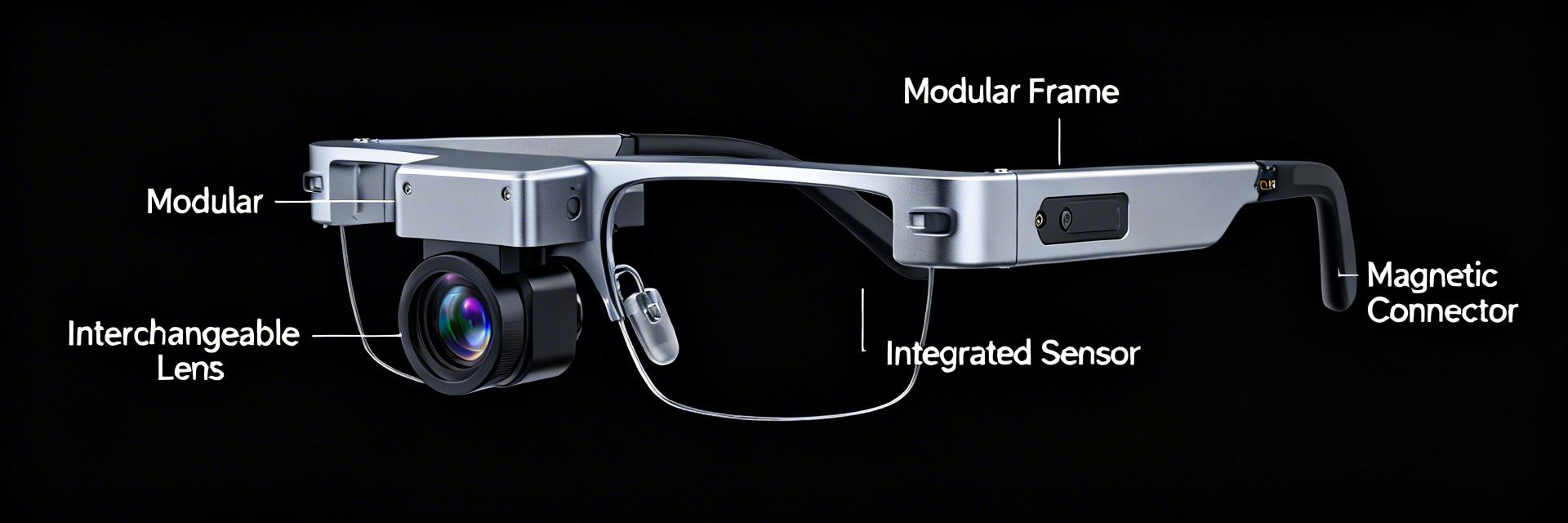
Canonical blocks simplify partitioning. By treating each block as a replaceable module, we achieve high reliability:
Enterprise AR prioritizes upgradability (extending product life by 2-3 years), whereas consumer AR focuses on industrial design. Modular approaches allow for "Pro" and "Lite" versions using the same core compute modules but different optical engines.
Technology indicators are only valuable when they translate to user experience:
"When designing the PCB for the compute carrier, always prioritize the return path for MIPI signals. We found that even a 0.5mm misalignment in pogo-pin arrays can introduce enough jitter to crash the display bridge at 90Hz. Use high-speed decoupling capacitors (0.1uF) as close to the PMIC output pins as possible to handle transient spikes during AI inference bursts."
A four-layer physical model balances function and manufacturability:
Hand-drawn sketch, not a precise schematic (Disclaimer: For conceptual reference only)
The technician uses the Compute Module for real-time CAD overlay. If the battery dies, they swap the Power Module in seconds without losing the system state, thanks to a small super-capacitor on the carrier board supporting hot-swaps.
Typical module budgets to ensure long-term reliability:
Prioritize optics and compute placement. Separating heat-generating compute from sensitive optical modules prevents image distortion and increases comfort.
Use-case driven targets are key. Allocate 2-6W for compute bursts and maintain a standby budget
Optical alignment verification after thermal cycling. Modular components must maintain sub-micron alignment even after 100 cycles of -10°C to +50°C.




{{ boxName }} ({{ dataList?.length || 0 }} Items)
{{ val.manufacturer || val.en_manufacturer || '' }}
auto.lang_Quantity: {{ val.quantity }}
auto.lang_null